





Bewerbungen an:
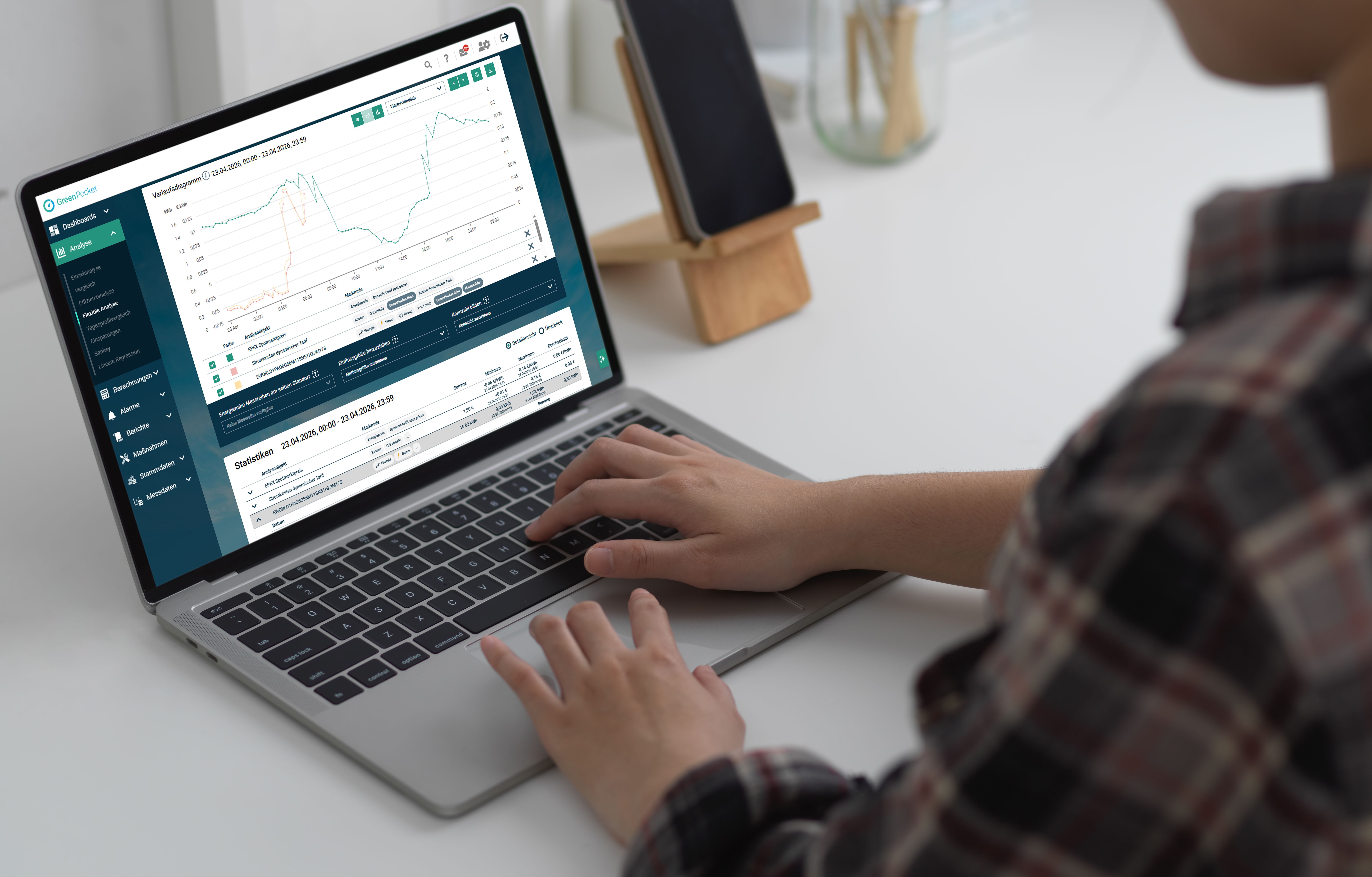
The new reporting feature in the GreenPocket energy management software enables the automated creation of customized energy reports - supported by integrated data gap detection and easy export in Word format for further editing.
Efficient energy management does not end with the analysis of individual consumption values. With increasing regulatory requirements, growing data volumes, and increasing complexity, one thing in particular is becoming a challenge: structured, compliant, and error-free reporting. What is still often associated with manual Excel spreadsheets, copy-paste processes, and time-consuming coordination must now function quickly, reliably, and at scale. This is exactly where the new reporting feature in our energy management software comes in. It supports companies in creating energy reports faster, in a more structured manner, and in compliance with standards—tailored to individual needs.
Typical Problems in Energy Reporting
Energy and sustainability managers are under increasing pressure. The number of mandatory standards and reporting requirements is constantly growing, from VDI guidelines and ISO 50001 to ESG and GHG reporting requirements. At the same time, data volumes are growing: locations, facilities, measurement points, consumption values, and key figures must be consolidated in a consistent way. In practice, manual reporting involves enormous personnel costs, a high susceptibility to errors, and uncertainty regarding data completeness. This shifts reporting from a mandatory task to a real obstacle to efficiency. An automated approach reverses this relationship: instead of having to prepare data manually, verified, consistent information is available in a structured form, reproducible and traceable at any time.
A Few Clicks to a Complete Energy Report
A reporting function integrated into the GreenPocket energy management software ensures that relevant data sources are automatically merged. Master data, consumption values, emissions data, and calculated key figures are fed into a central location and form the basis for meaningful reports. Both individual and bulk reporting are possible, for example by selecting multiple locations and specifying whether a comprehensive report or individual location reports should be generated. Downloading as a Word file in docx format ensures easy further editing and processing. Automated report creation and the elimination of manual data transfers result in significant time savings and a reduced error rate. This transforms reporting from a pure documentation tool into a reliable basis for decision-making.
Standard Report Templates and Automatic Completeness Check
Preconfigured standard templates are available to simplify report creation. These templates provide a structured representation of typical use cases, such as municipal energy reports or site reports, and can be customized and used as needed. This creates a consistent and technically sound basis for automated report creation.
A key advantage is the integrated data gap detection. Even before a report is created, the system automatically checks the completeness of relevant information and proactively prompts users to take action for data cleansing. Missing information is clearly marked and can be added directly in the digital twin without having to switch to another system or interface. This systematic quality assurance not only ensures reliable key figures and consistent comparability, but also reduces compliance risks and increases security during audits.
Further Development of the Reporting Feature
The new reporting feature already offers numerous functions for efficient and structured report creation. At the same time, the solution is being continuously developed. Future enhancements will make reporting even more flexible, customizable, and automated:
Greater Flexibility Through Drag-and-Drop Report Creation
Energy reporting requirements vary depending on the organization, industry, and objectives. Building on the existing standard templates, an enhanced template editor will offer additional customization options. This will allow existing templates to be adapted or new report templates to be assembled in a modular fashion. Content can be structured, prioritized, and flexibly combined.
Efficiency Through Reuse and Automation
With the planned report favorites, frequently used configurations can be saved and reused at any time. This means that the structure, time period, or selection criteria do not have to be redefined each time. In addition, scheduled jobs will be used to create time-controlled, automated report delivery to defined recipients — for example, on a monthly or quarterly basis.
This means no manual follow-ups, no missed deadlines, transparent delivery history, and lasting relief in everyday work. Once set up, the process runs reliably in the background, freeing up time for strategic tasks.
Professionalization of Energy Management
Modern, automated reporting is more than just a functional enhancement. It is a structural step toward professional, scalable energy management. The combination of intelligent data processing, automated analysis, and structured distribution creates a consistent process that is transparent and efficient. This turns an administrative task into measurable added value, with noticeable time savings, higher quality, and a clear basis for decision-making.
We would be happy to show you how you can efficiently automate your energy reports with the new reporting function. Feel free to contact us for more information.
* Für eine leichtere Lesbarkeit verwenden wir für Personengruppen das generische Maskulinum ("Benutzer", "Kunden" etc.). Selbstverständlich sind aber ausdrücklich alle Geschlechteridentitäten gemeint.


